Chapter One: A matter of principle
Ellsworth Speedball didn’t eat pizza. His best friend Moots Sperkel couldn’t understand. “Explain it to me again,” Moots said, his mouth already half full of cheesy pepperoni and his glasses dotted with greasy fingerprints.
“It’s not that I don’t like pizza,” Ellsworth replied. “That’s not it at all.”
This particular Thursday afternoon was hot, hot, hot. It was July in Sheron, Texas, and the boys were sitting in Ellsworth’s kitchen discussing his current lunchtime dilemma.
“You do like pizza.”
“Of course I do.” Ellsworth almost raised his voice. “I love it. I love it. I could eat boatloads of pizza.”
“Boatloads? Piled how high?” Moots questioned.
“Piled ten miles high.”
“What kind?” Moots asked.

“It looks really good.” Ellsworth had to look away.
“Moots, no. Stop. NO!” Moots finally put the slice down on his own plate and looked confusedly at Ellsworth.
“All right, then. Josiah.”
“Yes.”
“Your brother Josiah says he doesn’t like pizza. So now you don’t eat pizza?”
“Not exactly.” Ellsworth was pretty hungry by this point. He took a deep breath and then spoke again. “Josiah says that ‘pizza is a symptom of the state of society.’”
“I don’t know,” Ellsworth shrugged. “I just don’t know.”
Neither boy said anything for a few seconds. Then Moots almost whispered, “Well, then, how do you know it means you can’t eat pizza?”
“It has something to do with principle,” Ellsworth said. “I wrote it in my journal.” He knew he would never be able to get Moots to understand what he himself was having trouble grasping. He was hungry and was really beginning to grow a little miffed at society and its ill-information.
Moots leaned in toward Ellsworth and spoke even more softly than before. “You know, I won’t tell Josiah if you have a piece. I won’t tell anyone.”
Ellsworth looked once again at the pizza on the table. His mom had baked their lunch knowing that he wasn’t eating this particular food at present. She had dismissed his explanations with a wave of her hand. “Oh, your brother is ridiculous,” she said. “You can listen to him all you want and write down as many quotes of his that you want, but don’t let his righteousness come between you and your lunch, son.”
Ellsworth had tried to tell her that he didn’t feel he had any choice at this point and asked whether there wasn’t something else that she could make for him and Moots. “Look, E,” she replied, “the pizza is half-way done cooking. You like pizza. This lunch is fine. If you absolutely refuse to eat it, that’s fine, too. You feel free to make something else for yourself. But I don’t want a mess made of this kitchen, do you understand me?”
“Yes, ma’am,” he had nodded.
Now, Ellsworth looked at the slices remaining on the table. His stomach gurgled and he let his chin fall to his chest. “As I understand it, pizza was a contribution of the Chinese.”
“The Chinese?” Moots crinkled his forehead and pushed up his glasses with his grease-covered fingers.
“By way of Italy, yes.” Ellsworth eyed the rough, meaty disks lying atop the cheese that had begun to cool and harden. He took a big gulp. “After all, it is only lunch.”
“Yes! It’s only lunch.” Somehow empowered by the thought, Moots reached in and took his third piece from the pie in the center of the table.
“And I don’t want to hurt my mom’s feelings. If I don’t eat what she made us, I mean.”
“That’s right. Your mom has sensitive feelings.”
“That’s right.” Feeling his insides knot up out of hunger, Ellsworth hated keeping things from his older brother. Josiah knew and understood a lot more than Ellsworth did. But his stomach convinced him he had no choice. “It’s a matter of principle,” he said, straightening in his chair and readying to take action.
“That’s right. Principle,” Moots echoed. “What’s principle?”
“I don’t know,” Ellsworth said. “But we have to get out of here.” He began to stack the remaining pieces of pizza onto Moots’s plate. “You take the pieces. I’ll grab our drinks.”
“Where are we going?”
“HQ.”
“Oh, right. Of course. HQ.”
“We have to move quickly,” Ellsworth said. “And carefully. Josiah could be home any minute. If he sees us, I’m doomed.”
It was Moots who gulped this time. “Right.”
Ellsworth paused when everything was set and looked directly at his friend. “Are you ready for this sort of responsibility, Moots?”
Moots twitched the corners of his mouth and pressed his lips together, but never looked away. “I’m ready. You can count on me.”
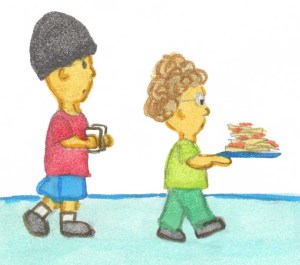 moment. They shot through the living room and over to the French doors that led to the back yard.
 “I’m bleeding,” he screeched, horrified, out of breath. He held up his arm and a thick streak of red paste smeared from his wrist to his elbow and was dripping onto his pants.
“You’re not bleeding. That’s pizza sauce.” Ellsworth leaned his back against the wall.
Moots’s face relaxed and he stared closely at the offensive streak. Before saying anything, he held his arm by the elbow and licked the redness from his forearm. “So it is,” he said. “Now that’s a relief.”
The boys finished their milk and pizza without saying another word.
***
 Ellsworth and Moots were both nine years old. Ellsworth was a little older, by a couple of months, but neither of them ever discussed their age difference out of respect for the feelings of the other.
 And so it was. Three girls, tall, skinny, and each with flowing blond hair came racing around the side of the truck to the front lawn where they ran around in circles, turned cartwheels, and kept shouting things like, “Our new house!” Far behind the girls, moving at a much slower pace and holding the hand of an adult version of the blond cartwheelers, was a boy. He was small, but not a toddler. Ellsworth couldn’t tell how old he was. The boy wore glasses; he seemed afraid.
Ellsworth moved from where he was sitting on his front porch out into the lawn and up to the edge of the street. The three blond girls continued to laugh and dance around and Mr. Sperkel had turned to the house and was now opening the garage door. Mrs. Sperkel led Moots to the front steps and sat him down with some instruction that Ellsworth couldn’t hear. Moots obediently sat while his mother began to corral his sisters up and move them back toward the truck. “All right, girls. That’s enough. We have a lot of work to do. Come on.”
Ellsworth stared at the boy on the steps. He wondered how old the new boy was. He wondered if he liked milk and worms and if he could ride a bike. The new neighbor looked like he  was freezing cold. He wasn’t watching his sisters or his parents, but instead taking in his new surroundings.
His eyes, through his broad-framed spectacles, scanned the front lawn, corner to corner to corner. They traced methodically past the mailbox, up the road and down the neighbors’ driveway. It wasn’t until his eyes left his neighbors’ mailbox that he noticed Ellsworth, standing near the road on the opposite side of the street.
The boys stared at one another. Moots’s expression didn’t change, yet, somehow, Ellsworth sensed that he was relieved. Freckles, missing front tooth, curly brown hair just like his dad. It looked like the coat he was wearing might be a girl’s.
Ellsworth brought his hand up to wave. Immediately, Moots moved his eyes away and turned his head, burying his face into his left shoulder. They wouldn’t actually meet that day. This boy, Ellsworth could see, would require some patience.
 The Rules According to Ellsworth Speedball
Leave a comment